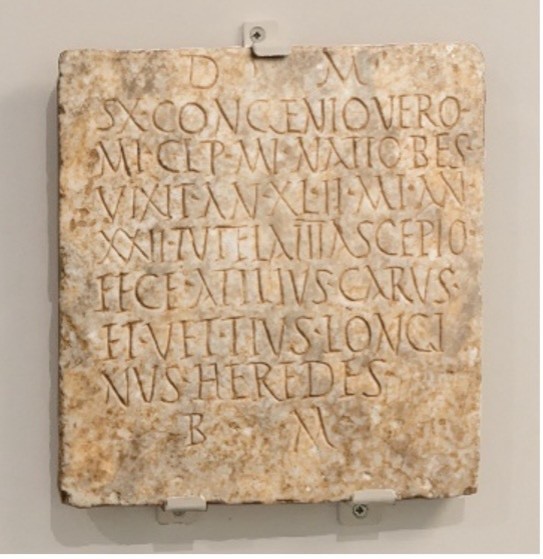
A Roman marble funerary plaque dedicated to Sextus Conceniu…
By Anonymous · published 29 Oct 2026
Interpretation
AI interpretation, unverified
SUMMARY
A Roman marble funerary plaque dedicated to Sextus Concenius Verus, a marine of the Praetorian Fleet of Misenum originally hailing from Thrace (the Bessi), erected by his heirs and fellow servicemen.
WRITING SYSTEM
Latin alphabet (Roman lapidary capitals with interpuncts)
LANGUAGE
Latin
TEXT
D · M SEX · CONCENIO · VERO · MIL · CL · PR · M · NATIO · BES VIXIT · AN · XLII · MIL · AN XXII · TVTELA · III · ASCEPIO FECE · ATTILIVS · CARVS · ET · VETTIVS · LONGI NVS · HEREDES B · M
TRANSLITERATION
D(is) M(anibus). / Sex(to) Concenio Vero, / mil(iti) cl(assis) pr(aetoriae) M(isenensis), natio(ne) Bes(so), / vixit an(nis) XLII, mil(itavit) an(nis) / XXII, Tutela, (trieri) Asce<l>pio. / Fece(re) Attilius Carus / et Vettius Longi/nus heredes / b(ene) m(erenti).
TRANSLATION
To the Spirits of the Departed. To Sextus Concenius Verus, soldier of the Praetorian Fleet of Misenum, of the Bessian nation (Thracian), who lived 42 years and served 22 years, [on the ships] Tutela [and] the trireme Asclepius. Attilius Carus and Vettius Longinus, his heirs, made [this monument] for him who well deserved it.
CONTEXT
A typical marble columbarium or burial slab from the necropolises surrounding Misenum (modern Miseno/Bacoli near Naples, Italy), the principal base of the western Roman imperial fleet (Classis Praetoria Misenensis). It dates to the imperial period, most likely the 2nd century AD (c. 100–200 AD).
CONFIDENCE
High
CAVEATS
• The GPS coordinates point to Espoo, Finland, which indicates the stone is on display in an exhibition, museum, or private collection rather than in its original archaeological findspot. • 'Bessus' designates an ethnic origin from the Bessi, a Thracian tribe heavily recruited into the imperial navy during the 1st to 3rd centuries AD. • 'III' is the standard epigraphic numeral/symbol for 'triere' (triremis, a trireme warship). Both 'Tutela' and 'Asclepius' (carved here phonetically as 'ASCEPIO') are well-attested names of ships in the Misenum fleet. • 'FECE' represents the archaic or poetic third-person plural perfect form 'fecere' (synonymous with 'fecerunt'), frequently encountered in imperial epigraphy.
LOCATION
Espoo, Finland
Exact position: 60.2354547, 24.6032579
Source of the position not recorded
Open in OpenStreetMap